 Nodus
One duration, two different comparisons
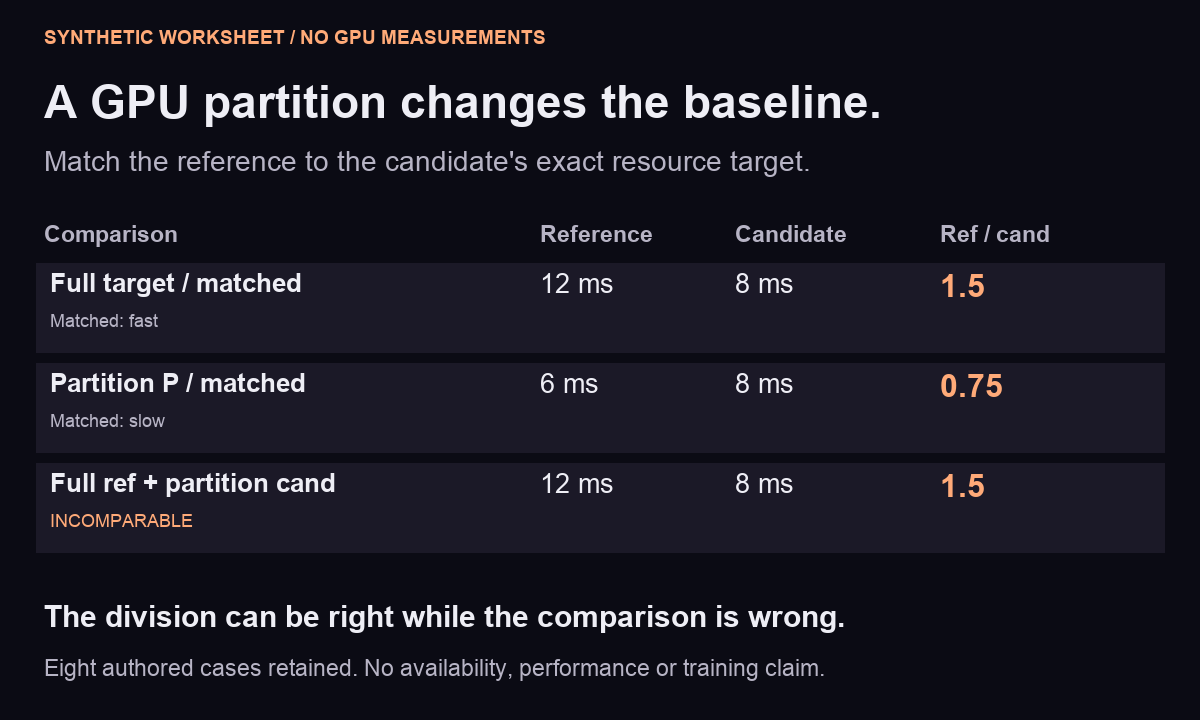
In this fictional example, a candidate takes 8 ms. Against a 12 ms reference on the full target, the matched comparison is 1.5×. On partition P, the matched reference takes 6 ms while the candidate takes 8 ms: 0.75×. The candidate is faster in the first comparison and slower in the second. These numbers are authored, not measured GPU performance.
Now combine the full-target reference with the partition candidate. The division still gives 12 / 8 = 1.5. What disappeared is the matched target. That number cannot support a claim that the candidate beats its partition baseline. The worksheet retains this mixed row and marks it incomparable.
The profile is part of the target
NVIDIA’s MIG guide distinguishes GPU instances from compute instances. A GPU instance has dedicated memory resources; compute instances within it share the parent’s memory and engines. Record the GPU model and both GI and CI configuration. A short partition label does not establish whole-device isolation.[1]
MPS also needs a mode and version. Dynamic active-thread limits do not reserve dedicated resources. Current NVIDIA documentation separately describes static SM partitions, where dynamic provisioning limits are ignored. “MPS” alone is not a resource specification, and neither configuration should silently stand in for a MIG profile. Verify support on the actual product and stack.[3][2][4]
A changed condition is another question
The worksheet also keeps the same partition P and changes the declared sibling-load condition. Its invented ratio changes from 0.75 to 1.5. That is a within-target label disagreement across conditions. It is not proof of a broken timer, noisy labels or an isolation failure.
If the objective is to reproduce an isolated-target reward, compare loaded evaluations against that predeclared isolated baseline. If the objective is performance under a particular load, retain that load in the target condition. Do not call the second objective wrong just because it differs from the first. Real estimates require repeated sessions and separately reported load strata.
Keep the unresolved cases
A near-tie row uses an invented 10 ms reference and 9.9 ms candidate, each with a declared absolute error bound of 0.2 ms. The resulting ratio envelope crosses the worksheet’s decision boundaries. It stays ambiguous. The preselected 1% neutral band is illustrative, not a universal threshold. These supplied error bounds are not confidence intervals; three identical authored repeats estimate no variance.
Both candidate and reference must have passing correctness declarations before a comparison is eligible. A wrong output and an unfinished attempt remain in the eight-row plan without an eligible performance result. All training-reward fields stay null: this artifact does not authenticate a grader, admit data or measure learning.
Make the comparison auditable
One reviewed local CPU run retained all eight fictional rows and matched all eighteen authored boundary controls. The original standard-library worksheet exposes every source-role binding, timing triple, label and declared error bound. Its controls cover missing or reordered attempts, wrong sources or targets, invalid durations, missing uncertainty and incorrect outputs. The MIT-licensed package can be inspected and replayed without a GPU or model.[5][6][7]
For an actual study, freeze the corpus and exact candidate/reference sources, verify correctness independently, interleave measurement order and retain raw synchronized timings. Match the stack, cache policy and exact resources. Report sibling-load conditions separately. Settled costs and downstream training benefit need their own evidence. No Nodus partition availability, provider ranking or hardware speedup is claimed here.
Sources
- NVIDIA MIG User Guide, release 620: Concepts docs.nvidia.com
- NVIDIA MIG User Guide, release 620: Supported GPUs docs.nvidia.com
- NVIDIA MPS: dynamic provisioning and static SM partitioning docs.nvidia.com
- NVIDIA MPS overview: opt-in v3 interface docs.nvidia.com
- Original fictional partition-baseline worksheet and retained result data.nodus-compute.ai
- Complete eight-row synthetic result and eighteen boundary controls data.nodus-compute.ai
- Original material, source and single-execution provenance data.nodus-compute.ai