 Nodus
Hold the answer fixed
This teaching example uses original synthetic text repairs, UTF-8 bytes and toy boundary symbols. It performs no model tokenization or training and makes no claim of model improvement.
To ask whether diagnostic input helps a model learn a repair, first check that the two data conditions ask it to produce the same answer. Otherwise a difference in the result could come from changed targets, missing examples or different loss masks rather than the diagnostic input.
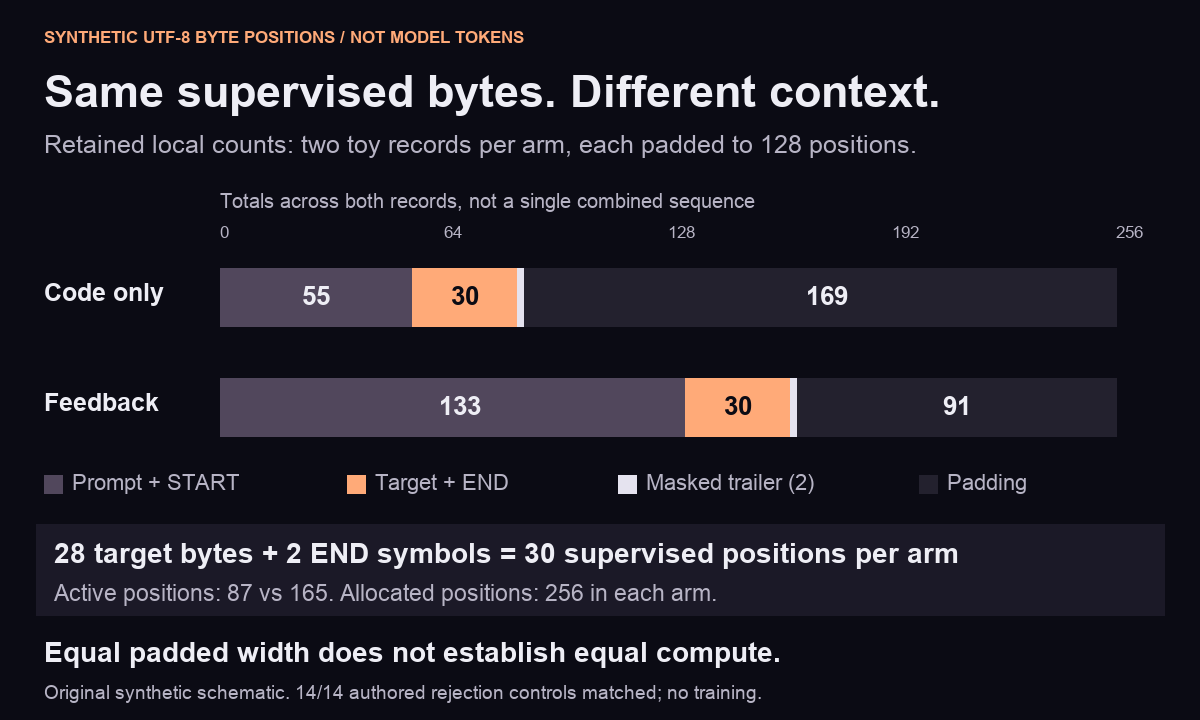
We built a small standard-library demonstration with two authored text repairs. Each has a code-only prompt and a prompt with an authored note, with exactly the same target. In the local check, both arms retain 30 supervised positions across the two records. Their active positions differ: 87 for code-only and 165 with feedback. These are UTF-8 byte positions plus toy symbols, not model tokens or compute measurements.[2][1]
Inspect the exact units
The representation is deliberately transparent: values 0 through 255 are UTF-8 bytes, with explicit toy START, END and PAD symbols. An accented character in one target occupies more than one UTF-8 byte. Neither a byte count nor a Unicode code-point count is a pretrained model token count.[1]
Both prompts have a fixed template. Only the treatment view adds the authored note, bound to the same toy input hash. A validator reconstructs that expected prompt for each arm; a self-consistent but wrong prompt is still rejected.[1]
The output shows full input, attention and unshifted-label arrays. Prompt positions, a formatting newline after END, and right padding are masked. Every target byte and END stay supervised. Longer prompts move the target to a different position, so compare the ordered supervised values rather than demanding equal padded arrays.[1]
Check what can quietly go wrong
All fourteen deliberate rejection controls matched their expected outcomes in one local run. They cover changed targets, hidden target bytes or END, prompt/trailer/padding supervision, premature label shifting, missing or reordered pairs, misplaced feedback, wrong input hashes, declared ancestor overlap, target data in evaluation metadata and context overflow. Every rejection remains in the downloadable result. These are authored checks, not failures observed from a training run.[2][1]
Overflow refuses the whole cohort. It never cuts off the difficult end of a target or removes a record to make the data fit. The single-shift index mapping in the result shows which earlier context position would be associated with each next label; it computes no logits, loss or gradient.[1]
Target equality is one control
Report active, padded and supervised positions separately. Both toy arms allocate 256 positions across two records: code-only has 87 active and 169 padding positions; the feedback view has 165 active and 91 padding positions. Both retain the same 28 target bytes and two END symbols. Equal targets and padded width do not establish equal attention work, FLOPs, wall time, gradients or effective training budget.[2]
With a real tokenizer, encode the full conversation using the pinned template, inspect prompt-to-target boundaries, retain the complete target and actual EOS, and reject boundary straddles or truncation. This byte schematic does not verify those properties for Qwen or any other model.
For the subsequent model comparison, freeze evaluation inputs without answers and apply the same evaluation prompt and decoder policy to unchanged-base, control and treatment models. Keep every planned failure and unfinished slot in the comparison. No evaluation or generation occurs in this demo.
Keep lineage and evidence separate
The toy group and input-hash checks find only declared collisions. They cannot prove that two real tasks are independent, authenticate compiler feedback, establish data rights or rule out unknown ancestry, semantic similarity, teacher leakage or pretraining contamination. Multiple views of one target do not become independent tasks.
The practical check is small: preserve the pair, reconstruct the intended prompt difference, compare the complete target and mask, and account for the context actually used. Passing it removes a possible data-interface mistake. It does not establish a useful training record or model uplift.[1]
Inspect and replay the check
The download includes the original script, both synthetic records, the complete retained result, provenance and MIT License. Run python3 -I -B paired_bytes.py --out replay-result.json with the Python standard library. The script refuses to overwrite a result, imports no production helper and makes no network or model call.[1][3]
Sources
- Download the original synthetic byte-position demo data.nodus-compute.ai
- Complete retained byte-position arrays and fourteen rejection checks data.nodus-compute.ai
- Original fixture, code and execution provenance data.nodus-compute.ai